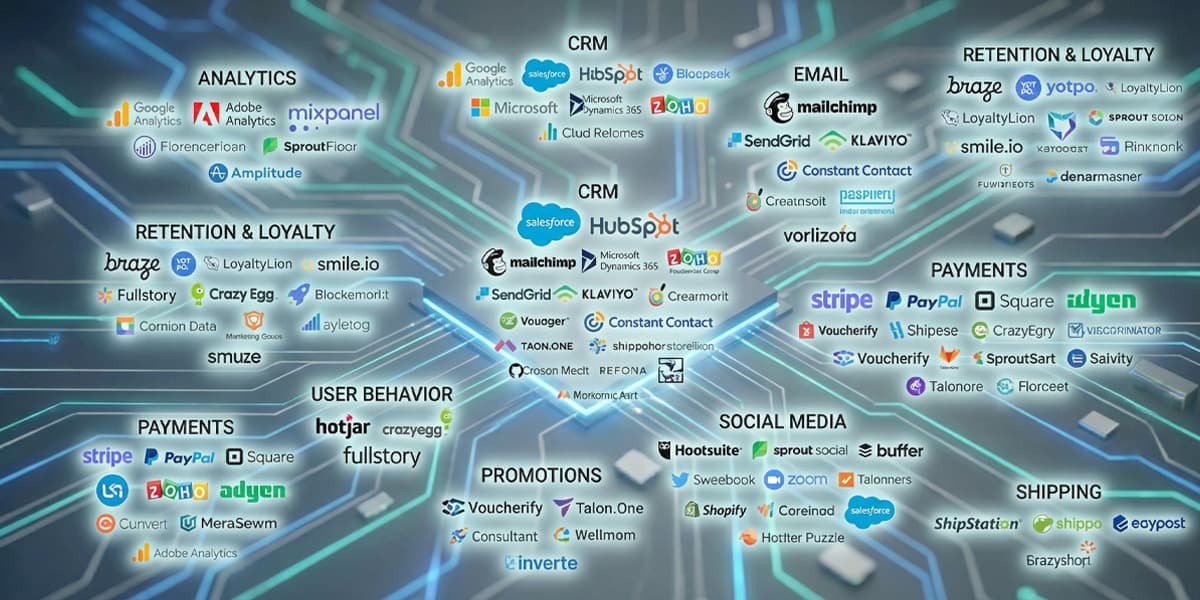
The Marketing Stack Is Dead. Long Live the Marketing System.
You don't have a marketing technology problem. You have 90 marketing technology problems stitched together with duct tape and prayer. Here's what replaces the stack — and why it matters more than you think.
15,384 Tools. Almost None of Them Talking to Each Other.
The martech landscape hit 15,384 solutions in 2025 — a hundredfold increase since 2011. The average enterprise uses over 90 marketing tools. And according to Gartner, only 49% of those tools are actively used.
Let that settle. Businesses are paying for twice as many marketing tools as they actually use. And the ones they do use? Most of them operate in isolation — separate logins, separate data, separate reports, no shared understanding of who your customer is or what they've done.
This is what happens when you build a marketing "stack." You solve each new problem by buying a new tool. Need email marketing? Buy a tool. Need social scheduling? Buy a tool. Need analytics? Buy a tool. Need a CRM? Buy a tool. Need a CDP to connect all the tools that don't talk to each other? Buy another tool.
Then you spend your time — or your team's time, or your agency's time — manually moving data between systems, reconciling conflicting reports, and wondering why your "marketing automation" still requires so much manual work.
This model is breaking. And AI is about to finish it off.
Why Your Stack Can't Survive the AI Era
The marketing stack model — a collection of independent point solutions loosely connected through manual exports, Zapier workflows, and hope — has three fatal problems in 2026.
AI needs unified data to work. Every AI system you deploy is only as good as the data it can access. When your customer data lives in six different systems with six different definitions of who a "customer" is, no AI tool can give you reliable results. You get hallucinated insights from fragmented inputs. The 65.7% of organizations reporting data integration difficulties aren't just dealing with an inconvenience — they're dealing with a structural barrier to every AI initiative they'll attempt.
Point solutions can't orchestrate. The emerging model of AI-driven marketing isn't about using AI within individual tools. It's about AI orchestrating across your entire marketing operation — adjusting email timing based on ad engagement, personalizing web content based on sales conversations, optimizing ad spend based on actual revenue data from your CRM. This kind of cross-channel intelligence is impossible when each tool is an island. You can have the best email AI, the best ad AI, and the best analytics AI — and still get worse results than a competitor with a mediocre but connected system.
Agents can't navigate a mess. AI agents — the autonomous systems that will increasingly manage marketing workflows — need clean, structured, accessible data to operate. They need to pull information from one system, make a decision, and act in another system, all without human intervention. A fragmented stack with inconsistent data, broken integrations, and manual handoffs is an environment where agents fail. The businesses deploying agents successfully in 2026 are the ones whose systems were already connected before agents entered the picture.
What a Marketing System Looks Like (vs. a Stack)
The shift from "stack" to "system" isn't just semantics. It represents a fundamental change in how marketing technology should be architected.
A stack is a collection of tools. Each one does its job. You're responsible for making them work together.
A system is an integrated architecture where data flows freely between components, AI can reason across the entire operation, and the whole is genuinely greater than the sum of its parts.
Here's what the shift looks like in practice:
Unified data foundation. Instead of customer data scattered across your CRM, email platform, ad accounts, analytics tools, and spreadsheets, a system consolidates everything into a single source of truth. Cloud data warehouses like Snowflake, Databricks, or BigQuery are increasingly serving as this foundation, with composable CDPs working directly on warehouse data rather than duplicating it. This isn't about buying one more tool. It's about restructuring how data flows through your entire operation.
Composable architecture. Rather than being locked into one vendor's monolithic suite (where you get best-in-class for two things and mediocre for everything else), a system uses modular components connected through standardized APIs. You choose the best tool for each function, but they all plug into the same data foundation and can be swapped without disrupting the rest of the system. Gartner projects that by 2026, the majority of CMOs will prioritize composability in their martech investments.
AI orchestration layer. This is the new piece that didn't exist two years ago. An AI layer that sits across your system and coordinates actions between components — adjusting campaigns based on real-time performance, routing leads based on behavior patterns, triggering workflows based on signals from multiple sources simultaneously. Scott Brinker's Martech for 2026 research found that 90.3% of marketing organizations now use AI agents somewhere in their martech stack. But the organizations getting transformative results are the ones where AI orchestrates across the system, not just within individual tools.
Human-defined strategy, machine-executed tactics. In a properly architected system, your team sets the objectives, defines the constraints, and makes the creative and strategic decisions. The system handles execution, optimization, and reporting autonomously. This is the shift from "AI-assisted mode" — where humans still define workflows and approve every action — to "AI-directed marketing," where the system determines the best path to achieve your stated goals.
The Consolidation Is Already Happening
This isn't a prediction. The market is moving.
More than 1,200 martech tools exited the market as financial and market pressures intensified. Platform providers — HubSpot, Salesforce, Adobe — are expanding their suites aggressively, absorbing capabilities that used to require separate tools. The traditional CDP category is eroding, with its share dropping from 26.9% to 17.4% as the center of B2C martech stacks, as capabilities migrate to either the data warehouse layer or engagement platforms.
Meanwhile, a quarter of organizations are now planning to build custom martech solutions in the next 12-24 months — up from 2% just months earlier. AI-powered development tools are making it possible for businesses to build exactly the integrations and workflows they need, rather than settling for what off-the-shelf products offer.
The message from the market is clear: the era of accumulating tools is ending. The era of architecting systems is beginning.
What This Means for Your Business
If your marketing technology looks like a patchwork of disconnected tools — each doing one thing adequately but none of them working together — you're not just dealing with operational frustration. You're sitting on a structural disadvantage that will deepen as AI becomes central to marketing execution.
Here's the honest assessment of what most businesses face:
You're probably paying for tools you don't use. With only 49% utilization rates across the industry, the odds are strong that you're carrying dead weight in your martech budget. An honest audit — not of what tools you own, but of what tools actively contribute to revenue — will likely reveal significant waste.
Your data is probably fragmented. If getting a unified view of a customer requires pulling data from multiple systems and reconciling it manually, your data isn't ready for AI. It's not even ready for basic segmentation. This is the single biggest barrier to marketing effectiveness in 2026, and no amount of AI tooling fixes it if the underlying data architecture is broken.
Your integrations are probably fragile. If your marketing operations depend on Zapier workflows, manual CSV exports, or "it works if you don't touch it" custom integrations, you have technical debt that will become a crisis as you try to adopt more sophisticated AI capabilities.
The businesses that address these issues now — consolidating tools, unifying data, building proper system architecture — are the ones that will be able to deploy AI effectively when (not if) it becomes table stakes for competitive marketing.
Frequently Asked Questions
What is a marketing technology stack?
A marketing technology stack (or martech stack) is the collection of software tools and platforms a business uses to plan, execute, and measure marketing activities. A typical stack includes CRM, email marketing, social media management, analytics, advertising platforms, content management, and various automation tools. The challenge is that most stacks grow organically — each tool added to solve a specific problem — resulting in fragmented, poorly integrated collections of software that don't share data effectively.
How many martech tools does the average company use?
The average enterprise uses over 90 marketing technology tools, though utilization rates are low. Gartner research shows that only 49% of martech tools are actively used, meaning companies are paying for roughly twice as many tools as they need. The martech landscape has grown to over 15,384 solutions as of 2025, representing a hundredfold increase from approximately 150 tools in 2011.
What's the difference between a marketing stack and a marketing system?
A marketing stack is a collection of independent tools where each performs a specific function. A marketing system is an integrated architecture where data flows freely between components, AI can operate across the entire operation, and tools are connected through a unified data foundation rather than manual exports or fragile integrations. The key distinction: a stack requires humans to coordinate between tools, while a system enables AI to orchestrate across the entire marketing operation.
Why is data integration the biggest problem in marketing technology?
Data integration is the top challenge because every other marketing capability depends on it. AI tools, personalization engines, attribution models, and automation workflows all require clean, unified customer data to function effectively. When data is scattered across disconnected systems — with different formats, different definitions, and no reliable way to connect them — every downstream capability suffers. Research shows that 65.7% of organizations face data integration difficulties and over a third cite integration as their top martech challenge.
Should I consolidate my marketing tools or build custom solutions?
Both approaches are valid depending on your situation. Consolidating around a major platform (HubSpot, Salesforce, Adobe) reduces integration complexity but may force compromises on functionality. Building custom solutions offers maximum flexibility and increasingly, AI-powered development tools make this more accessible. The emerging best practice is a composable approach: choose a core platform for your primary functions, supplement with best-in-class specialized tools where needed, and connect everything through a unified data layer and standardized APIs.
How do I start fixing my martech mess?
Start with three steps. First, audit what you actually use — not what you're paying for. Cancel or consolidate tools that overlap or go unused. Second, identify your data gaps: can you get a unified view of a customer across all your systems without manual work? If not, that's your priority. Third, map your integrations: where does data flow automatically, where does it require manual intervention, and where does it not flow at all? The answers will tell you where to invest first. Most businesses find that fixing the data and integration layer delivers more improvement than adding any new tool ever could.
What role does AI play in marketing technology in 2026?
AI is embedded at every level of marketing technology in 2026. Over 90% of marketing organizations now use AI agents somewhere in their martech operations. AI handles content generation, campaign optimization, audience discovery, personalization, and increasingly, autonomous workflow management. However, AI's effectiveness depends entirely on the quality of the data and system architecture beneath it. Organizations with unified, well-integrated systems see transformative results from AI. Organizations with fragmented stacks see marginal improvements at best.
Is it worth investing in marketing technology right now given how fast things are changing?
Yes, but invest in architecture rather than specific tools. Individual tools will come and go as the market consolidates and AI capabilities evolve. What won't change is the need for clean, unified data; reliable integrations between your core systems; and the ability to deploy AI across your marketing operation. These foundational investments retain their value regardless of which specific tools you're using in 12 or 24 months. Think of it as investing in plumbing rather than fixtures — the pipes last longer and matter more than the faucets.
Catalyst Studio specializes in the exact work that turns a fragmented marketing stack into an integrated marketing system — connecting disconnected platforms, building data pipelines, architecting API integrations, and creating the unified infrastructure that makes AI-powered marketing actually work. If your tools don't talk to each other, that's literally what we solve. Let's fix it.